
Living
Reading Time:
5
Minutes
What the African Hair Salon Understands About the Art of Slowing Down
GLOW SNAPSHOT
What This Is An observation of the African hair salon as a complete wellness space and what it teaches the world about the art of being present with another person.
Who It's For Anyone who has ever sat in a salon chair and felt something shift. Anyone who has wondered why certain spaces make people feel more human than others.
Why It Matters Because the African hair salon has been practising a complete vision of human flourishing for generations without calling it wellness. The world is only now beginning to understand what it already knew.
It begins before you sit down.
Someone calls your name. Not your number. Your name. There is a greeting, sometimes long, sometimes elaborate, always genuine. How are you. How is your mother. How did that thing go, the one you mentioned last time. You are not a client arriving for a service. You are a person arriving for a conversation that happens to include hair.
This is the first thing the African hair salon understands that most of the wellness industry is still trying to learn.
Presence is not a technique. It is a culture.
The economics of slowness
In most service industries, time is the enemy. The faster the turnover, the higher the revenue. Speed is optimised for. Efficiency is the goal. The client is a transaction to be completed.
The African hair salon operates by a different logic entirely.
A single appointment can last three hours. Sometimes four. Sometimes more. The time is not considered wasted. It is considered necessary. Not because the technical work demands it, though often it does, but because the experience is understood to include something beyond the technical work.
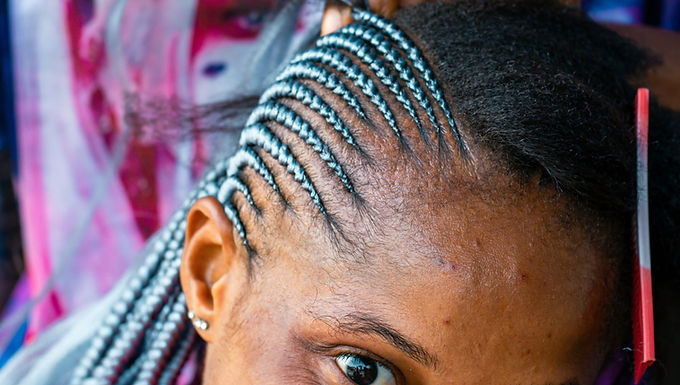
Braiding, threading, loc maintenance, relaxing, pressing — these are not quick procedures. They are extended acts of care that require the practitioner to be in sustained, focused, physical contact with another human being for a significant period of time.
In that time, something happens that no spa menu has ever successfully packaged.
Community forms.
What actually happens in three hours
The chair fills. The conversations begin. The person next to you is talking about her sister's wedding. The woman under the dryer is asking for advice about her landlord. The practitioner moves between clients with a fluency that suggests she is not just doing hair. She is holding a space.
Information moves. Problems are named. Solutions are offered. Stories are told and received. Laughter happens, real laughter, the kind that comes from genuine familiarity rather than performed friendliness.
People arrive carrying the weight of their week. They leave lighter. Not because anything was fixed. But because they were heard, touched with care, and held inside a room where they fully belonged.
The African hair salon does not advertise itself as a wellness space. It has never needed to. Its clients already know what they are coming for, even when they cannot name it.
They are coming to be seen. To be touched with care. To belong to a room where their hair, their culture, their particular kind of beauty is not an exception but the entire point.
The ritual of hair as identity
Hair in African culture has never been merely aesthetic.
It has been language. Status. Spiritual protection. Cultural identity. Political statement. A map of belonging that others in the community could read at a glance.
Braiding patterns communicated tribal origin, marital status, age, and social position. The care of hair was communal, passed between generations, mothers to daughters, aunts to nieces, elder women to younger ones. It was one of the primary ways cultural knowledge traveled through bodies rather than books.
When the African hair salon exists in Bangkok, or Tokyo, or London, or São Paulo, it carries this history with it. The practitioner may not narrate it. The client may not consciously recall it. But it is present in the quality of attention, the patience of the hands, the understanding that what is being tended is not just hair.
It is identity. And identity, when it is honoured rather than ignored, is one of the most powerful acts of care that exists.
What minimalism forgot
The dominant aesthetic of contemporary wellness spaces is reduction.
White walls. Silence. Negative space. The removal of stimulation as a path to calm. This is a valid approach. It works for certain people in certain moments.
But it assumes that wellbeing lives in absence.
The African hair salon offers a different argument entirely.
Wellbeing lives in abundance. In conversation. In the sound of multiple languages overlapping. In the smell of products that connect you to somewhere specific. In the texture of a space that has been used, really used, by real people bringing their whole lives into it.
The African hair salon is full. It is warm. It is loud in the particular way that only genuine community is loud. Not chaotic. Not overwhelming. But alive.
And people leave it feeling better than when they arrived.
Not because they were given silence. But because they were given presence.
The GLOW ON lens
GLOW ON for Africa did not invent this understanding of wellbeing.
It grew up inside it.
The founder of GLOW ON was raised in a hair salon. Not metaphorically. Literally. She watched, from childhood, how the quality of attention a practitioner brought to their work changed how a client moved through the rest of their day. She observed how a space could hold a community together through conversation, through care, through the simple act of one person tending to another with genuine focus and skill.
She watched something extraordinary happen in an ordinary room, every single day, before she had a language to describe it.
What she saw was not a beauty business. It was a care system. One that had been operating without recognition, without formal structure, and without the economic returns it deserved, for generations.
GLOW ON exists in part because of what that salon taught. That care is not soft. It is structural. That presence is not a personality trait. It is a practice. That slowing down is not inefficiency. It is the entire point.
What the industry is still learning
The global wellness industry spends billions trying to manufacture what the African hair salon offers naturally.
Programmes that teach people to be present with one another. Community initiatives that try to recreate the belonging that forms organically in spaces where people gather regularly around a shared practice. Therapies that understand the healing power of skilled, intentional human touch.
All of it is pointing toward something the African hair salon has always known.
You cannot separate the wellbeing of a person from the community around them. You cannot separate the healing of the body from the honouring of the identity that lives in it. You cannot separate the quality of a service from the quality of the attention behind it.
The skill of the hands. The consistency of the practice. The systems that make care repeatable. The economic and cultural value that emerges when all of it works together.
The African hair salon practises all of it. It always has.
It just never called it a framework.
GLOW Synthesis
The wellness industry is searching for authenticity. For presence. For the kind of care that makes people feel genuinely seen rather than efficiently processed.
It has been available all along.
In a salon chair. In a room full of conversation. In the hands of a practitioner who understands that tending to someone's hair is an act of profound cultural and human significance.
The African hair salon does not slow down because it is inefficient.
It slows down because it understands something the rest of the industry is still catching up to.
That when you give a person your full presence, your genuine attention, your unhurried care, you are not wasting time.
You are doing the most important work there is. 🌍
GLOW ON for Africa™ If it makes you more fully alive, that is wellness.